



Cart
Loyalty program
First time here? Join X-Bar and our loyalty program before placing your order — create your account now and unlock exclusive promo codes!
Warning: The sale of vaping products is strictly prohibited to minors under 18 years of age (Article L3513-5 of the French Public Health Code).
We hear everything and its opposite. One day a miracle cure, the next accused of all evils: the danger of e-cigarettes is a subject that unleashes passions. However, for smokers looking for a way out of their consumption, it’s important to move beyond alarming headlines to focus on facts.
Let’s be transparent from the start: breathing anything other than pure air always carries a risk. However, the real question isn’t whether vaping is perfect, but whether it represents a massive risk reduction compared to smoking. So, what does science actually say about the dangers of e-cigarettes? Let’s break it down.
To assess the harmfulness of a product, we must first understand its mechanics.
The principle is simple: a battery sends energy to a coil – a small metal wire surrounded by cotton. When heated, this coil transforms the liquid into an aerosol. This is where the fundamental difference from a traditional cigarette lies: there is no combustion.
Where a traditional cigarette burns tobacco at 800°C, generating tar and ash, the e-cigarette simply heats a liquid. This absence of carbon monoxide, the gas that suffocates your arteries, is the first major argument in favor of vaping. It’s a “clean” technology in the sense that it doesn’t alter the chemical structure of ingredients through fire.
If you flip over a cigarette pack, the ingredient list is nowhere to be found. And for good reason: smoke contains over 4,000 substances. Conversely, the composition of e-liquids is known and controlled. You’ll find at most four elements:
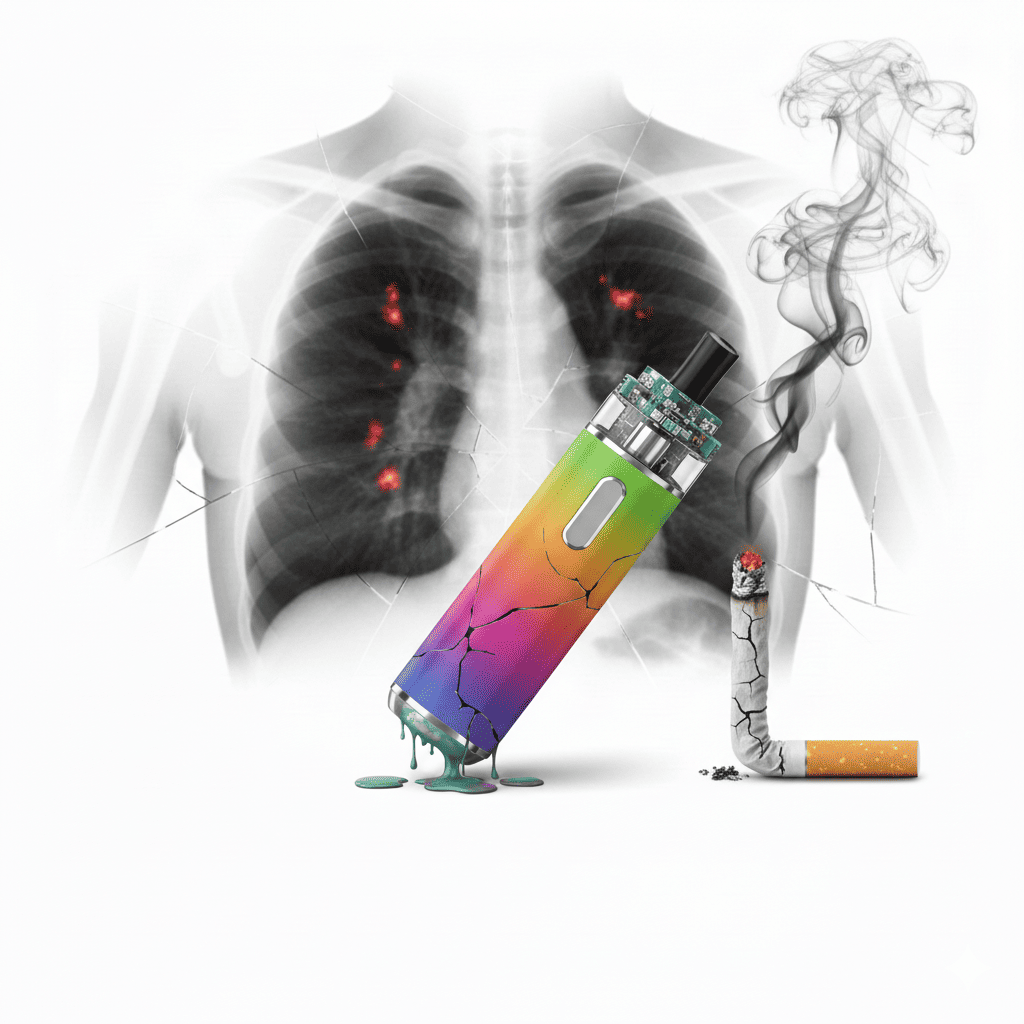
This is the heart of the debate. When comparing the two products, the match is clear-cut from a toxicological standpoint.
The scientific consensus is solid. According to research and the now-famous report by Public Health England – the English public health agency, vaping is estimated to be 95% less harmful than tobacco. Why such a gap? Because the deadly danger of cigarettes is linked to smoke from combustion, not nicotine itself.
By switching to vaping, you eliminate major carcinogenic substances like tar that lines the lungs. It’s a drastic reduction in exposure to toxic substances and the resulting diseases. However, this also depends on the equipment you choose and how you use it.
Vapor isn’t just water; it’s an aerosol containing fine droplets. Some studies have occasionally detected traces of aldehydes – irritating substances – in vapor. Pay attention to the context of this data: substances generally appear during “overheating” of the liquid. In the throat, this is characterized by the famous burnt taste or dry hit.
This is where equipment choice comes into play. Complex e-cigarettes, for example those where users manually adjust power in watts, present a risk of human error. So, if you heat too intensely, you degrade the liquid.
Conversely, a calibrated system like a rechargeable X-Bar puff heats at a constant and controlled temperature, preventing the formation of these undesirable compounds. Simplicity here is a guarantee of health safety.
Wrongly demonized, nicotine is often confused with the harmful effects of tar. However, we need to provide factual elements on this subject.
Nicotine is a psychostimulant, similar to caffeine in its effects.
Yes, it maintains physical dependence and makes quitting difficult, especially when you started young. That’s its main drawback. However, it doesn’t directly cause cancer at doses consumed by a vaper or smoker.
The danger is the smoke that accompanies it in a traditional cigarette, not the molecule itself.
Overdosing – headaches – or underdosing – feeling of withdrawal – are classic pitfalls. For effective smoking cessation, you shouldn’t be afraid of nicotine. Current devices allow you to precisely adjust this level: 20mg, 10mg, or 0mg.
The most common mistake is wanting to lower this level prematurely. Depriving your brain of nicotine abruptly almost always leads to buying another pack of cigarettes, which is infinitely more dangerous for your health.
What actually happens in your body when you replace smoke with vapor?
The first few days can be surprising. Some experience temporary coughing. This is often a sign that the cilia in your bronchi, paralyzed by tobacco, are starting to function again and evacuate waste. Dry mouth due to Propylene Glycol can also be noted. But very quickly, the benefits take over: taste and smell return, and the typical throat irritation of smokers disappears.
This is smokers’ major concern. Clinical studies show rapid improvement in respiratory capacity among smokers who switch exclusively to vaping. Asthmatic patients or those suffering from COPD – Chronic Obstructive Pulmonary Disease – often see their symptoms decrease. Since vapor lacks solid particles, it’s much less aggressive to lung tissue.
Nicotine temporarily increases heart rate and blood pressure, that’s a fact. This is why vaping isn’t recommended for people who have never smoked. However, the risk of heart attack is mainly linked to carbon monoxide and thrombogenic agents in smoke, which disappear with vaping. Switching to e-cigarettes therefore significantly reduces cardiovascular risks compared to smoking.
This is the question everyone asks. To date, with over 15 years of hindsight, no serious study has demonstrated that vaping causes cancer in humans. Proven carcinogenic substances from tobacco – benzene, arsenic, chromium… – are absent or present at undetectable levels in a quality vaping system. Although science continues to monitor very long-term effects, the risk of developing cancer from vaping is considered minimal compared to smoking.
If vaping is less dangerous, liquid and equipment quality are points that absolutely cannot be neglected. News stories about “explosive” or toxic vapes almost exclusively concern contraband products or somewhat hazardous homemade modifications.
At X-Bar, we NEVER compromise on safety. Our products strictly comply with the TPD – European Tobacco Products Directive, which imposes drastic standards:
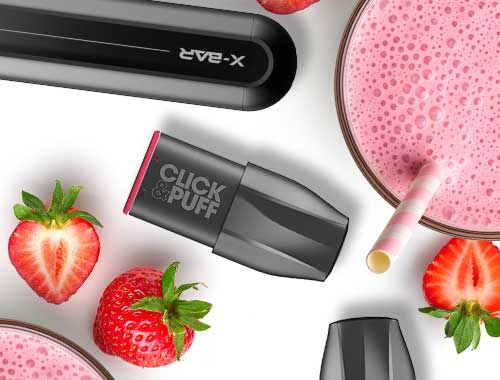
Opting for a closed system like our Click & Puff means choosing peace of mind. No coil to change, source of leaks or unwanted flavors, no random voltage adjustment. You have the assurance of equipment that always heats at the ideal temperature, guaranteeing healthy vapor and a pleasant and safe vaping experience.
Yes, it’s a scientific certainty. The absence of combustion eliminates thousands of toxic compounds. It’s a harm reduction tool. Be aware, it’s not a wellness product, but it’s much less aggressive to the body than traditional tobacco.
Yes, if it contains nicotine. This is why its use is discouraged for non-smokers. For a smoker, this nicotine dependence simply replaces that of cigarettes, but with a much less harmful method of administration.
Yes. According to Cochrane – the world reference for medical meta-analyses, e-cigarettes with nicotine are more effective for smoking cessation than traditional nicotine substitutes like patches or gum.
While “zero risk” doesn’t exist, the danger of continuing to smoke is certain and deadly: 1 in 2 smokers dies from it. E-cigarettes stand as the most pragmatic and least dangerous alternative to quit tobacco. The key is choosing reliable and certified equipment.
Sale prohibited to minors. Product that may contain nicotine, an addictive substance. Use by non-smokers not recommended.